"95% of Habits Run on Autopilot" — Charles Duhigg on Designing the Habit Loop to Automate Your Life
For anyone who can't sustain habits through willpower. From 'The Power of Habit' author Charles Duhigg, BJ Fogg, and Soichiro Honda, learn the science of designing a cue-routine-reward habit loop that automates your life.
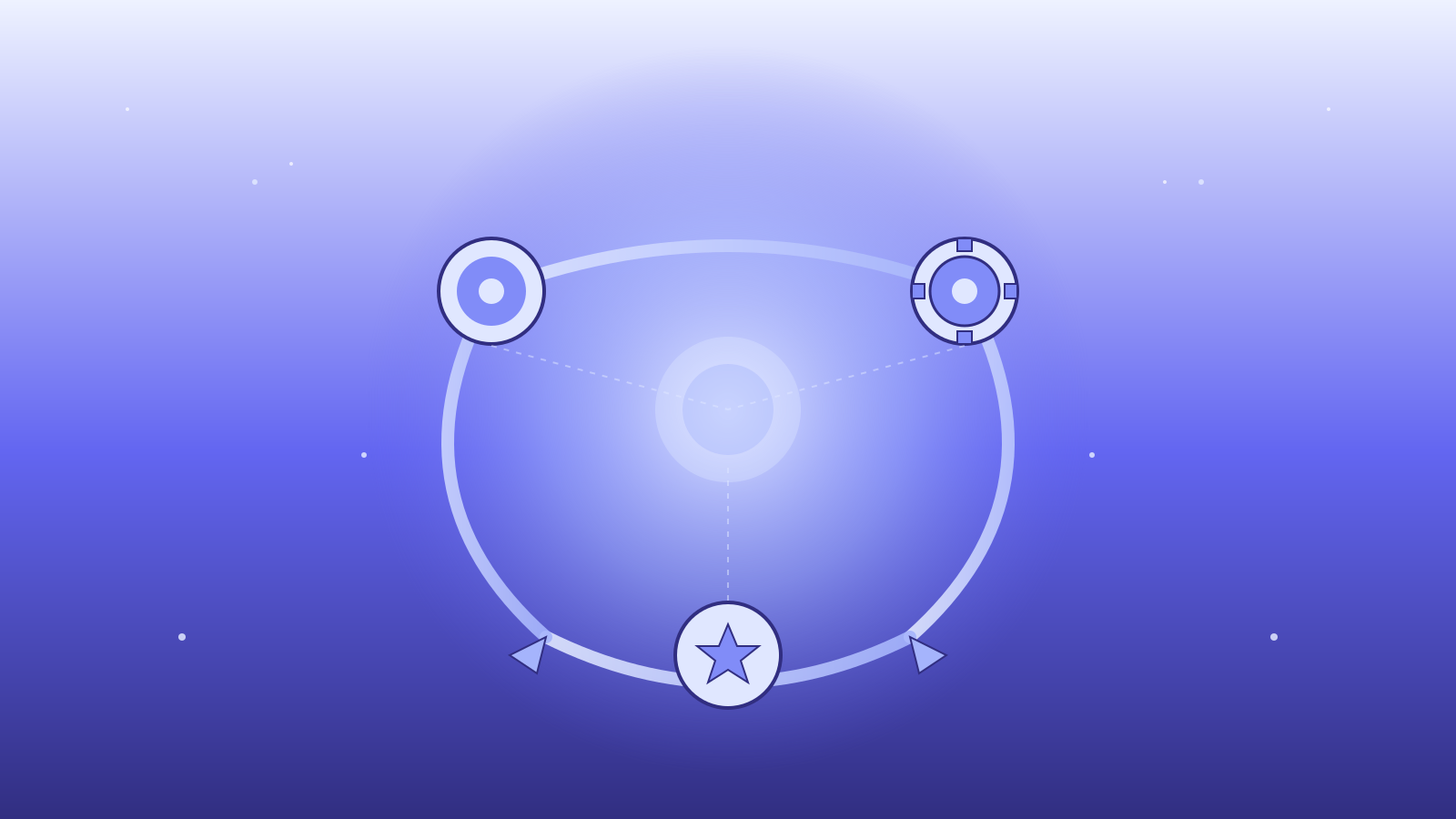
Duhigg's Revelation: '95% of Habits Run on Autopilot'
In the opening of his global bestseller 'The Power of Habit,' Pulitzer Prize-winning journalist Charles Duhigg presented a striking fact: '40–45% of our daily actions are not conscious choices but habits performed automatically.' Later neuroscience pushed the number higher: when you include patterns of behavior, 'an unconscious loop governs as much as 95%.'
What this means is that if you want to change your life, replacing the contents of the unconscious 95% is far more efficient than trying to power through with willpower. Will is fuel; habit is the engine. Pouring in more fuel without changing the engine can't carry you for long.
Citing MIT neuroscientists, Duhigg pinpointed three elements common to every habit: cue, routine, and reward. Design these three deliberately, and your 95% becomes your ally.
The Three Elements: Cue, Routine, Reward
A cue is the switch that tells the brain, 'Start autopilot from here.' Time (an alarm at 7am), location (standing at the front door), emotion (feeling anxious), preceding action (making coffee), the presence of others (a colleague gets up) — one of these five becomes the cue for almost every habit.
A routine is the action program the brain auto-plays in response to the cue. Whether you place a workout, a social-media scroll, or a deep breath here determines the very content of your habits.
A reward is the payoff the brain receives immediately after the action. It is what makes the brain consolidate the memory of 'when this cue appears, run this routine.' Rewards don't have to be material — achievement, relief, recognition from others, even a visual record can be powerful rewards.
One full cycle of these three is the 'habit loop.' Both good and bad habits run on this same structure, so the strongest strategy to erase a bad habit is to keep the cue and reward, and replace only the routine.
BJ Fogg's 'Tiny Habits' and Why You Start Small
BJ Fogg, founder of the Stanford Behavior Design Lab, took Duhigg's theory deeper into practice. The core of his 'Tiny Habits' is one simple formula: 'Behavior = Motivation x Ability x Prompt.'
What matters here is that motivation swings unreliably day to day, so you design 'ability (ease)' and 'prompt' so that even with low motivation, the action runs automatically. Fogg's famous prescription is, 'Make it laughably small at first.'
Not 'thirty push-ups a day' but 'after brushing teeth, do one push-up.' Not 'one hour of English study' but 'when you open your laptop, check one word.' These are sizes so small the brain doesn't feel tired before starting, so as long as the cue arrives, the action runs. Each tiny success deposits a small reward (a sense of having done it) in the brain, and the loop strengthens. This is the essence of forming habits without relying on willpower.
Soichiro Honda on 'Continuity That Turns the Ordinary Into the Extraordinary'
Soichiro Honda, founder of Honda, said, 'Success is the 1% supported by 99% of failure.' He also repeated to his employees, 'The only way an ordinary person becomes extraordinary is to do the thing they decided to do, every single day.'
From his backstreet-workshop days onward, for over sixty years, Honda is said to have stood at the factory at the same hour each morning, in oil-stained work clothes, before the machines. For him, showing up at the factory was no longer 'a goal pursued with grit' — it had become 'a habit like brushing teeth.' The moment an action leaves the domain of will, it becomes explosively sustainable.
Honda's line 'once you've decided, don't think — move' is not emotional rhetoric, but the field wisdom of someone who understood the habit loop. 'Thinking' depletes will. 'Moving,' tied directly to a cue, drives resource consumption near zero. Behind the global empire he built in a single generation was this organizational migration from 'thinking' to 'habit.'
Four Steps to Design Your Own Habit Loop Starting Today
Here are four concrete steps to design a habit loop on purpose.
First, anchor the cue to an existing habit. Place a new habit immediately after something you already do every day without fail. Example: 'Right after making morning coffee, open the vocabulary app for three minutes.' This is called 'habit stacking.'
Second, make the action laughably small. For the first two weeks, shrink it down to a size that feels almost embarrassing. One push-up, one page of reading, one line in a journal. Actions too small to fail keep the loop intact on busy or exhausted days.
Third, design an immediate reward. Place something the brain registers as 'pleasure' right after the action. Tick a record app, play one favorite song, message someone with your progress — these signal to the brain, 'this action pays off.'
Fourth, shape the environment so the action is easy. To make exercise a habit, put workout clothes by the bed before sleep. To make reading a habit, remove the social-media app from the home screen and place a book in its line of sight. In behavioral science, environment beats will every time.
Keep these four steps for two months and a new neural circuit thickens; the action launches automatically the moment the cue appears.
A Book by the Bed That Changed My Nights
A personal aside. There was a period when I came home exhausted from work, and before sleep I would idly scroll my phone until well past midnight. I kept thinking, 'I want to read,' 'I want to sleep earlier' — and yet I would open social media every single night, and grew tired of myself.
One evening, in a small conversation with family, someone said, 'You could just stop putting your phone by your pillow.' That night I tried it — I placed the phone on a desk across the room, and in its place by the bed I put a book I had started ages ago and never finished. That was the entire intervention.
The next night, as I got into bed, my hand reached out and there was no phone — only the book in my line of sight. Without thinking, I picked up the book. I read just two pages. And yet, that night, I fell asleep astonishingly fast. Back when I had been telling myself with willpower, 'don't look at the phone,' it would have been impossible. Just by swapping the object I reached for at the cue (getting into bed), the entire shape of the evening changed. I still remember it vividly.
Don't 'Eliminate' Bad Habits — Replace Them
One of Duhigg's most important findings is that 'bad habits cannot be erased; they can only be replaced.' Once a loop is carved into the brain it physically remains as neural circuitry; it can't be cleanly deleted.
But you can keep the cue and the reward and swap only the routine. For example, if you struggle with 'feel stress (cue) → eat snacks (routine) → calm down (reward),' you can replace it with 'feel stress → take ten deep breaths → calm down,' keeping cue and reward intact while making the routine healthy.
Whether you understand this 'replacement strategy' changes your win rate against bad habits dramatically. Suppressing them with willpower almost always fails. Designing for replacement is the scientifically backed path to victory.
Make Your 95% Work for You
Duhigg's 'Power of Habit,' Fogg's 'Tiny Habits,' Honda's 'don't think — move' — knowledge from different eras and countries all converges on the same conclusion: 'What changes a life is not the volume of will, but the quality of habit design.'
Starting today, take one new habit and design it through the three elements: cue, routine, reward. Make it laughably small. 'After making coffee, check one English word.' 'After brushing teeth, do one squat.' Don't mock the smallness — try it for three months.
When you notice it, your daily 95% will no longer be 'something you have to push through.' It will have become a powerful engine that carries you to your destination without spending a single drop of will.
About the Author
Success Quotes Editorial TeamWe share timeless quotes from the world's greatest achievers in a way that is easy to understand and applicable to modern life.
View author profile →Related Articles
"The Only Condition for Building the Best Team Is Psychological Safety" — Amy Edmondson on Creating Organizations Where People Can Speak Without Fear
"Your Brand Is What People Say About You When You're Not in the Room" — Jeff Bezos on How Reputation Builds Your Network
"It Is Not Enough to Be Busy — So Are the Ants. The Question Is, What Are We Busy About?" — Thoreau on Turning Busyness into Real Results
"Show Them, Tell Them, Let Them Try, Then Praise Them" — Isoroku Yamamoto on Leadership That Actually Moves People