"The Only Condition for Building the Best Team Is Psychological Safety" — Amy Edmondson on Creating Organizations Where People Can Speak Without Fear
Google's 'Project Aristotle' proved the one common trait of top teams is psychological safety. Learn from Harvard's Amy Edmondson, Satya Nadella, and Kazuo Inamori how to build a team where people speak without fear.
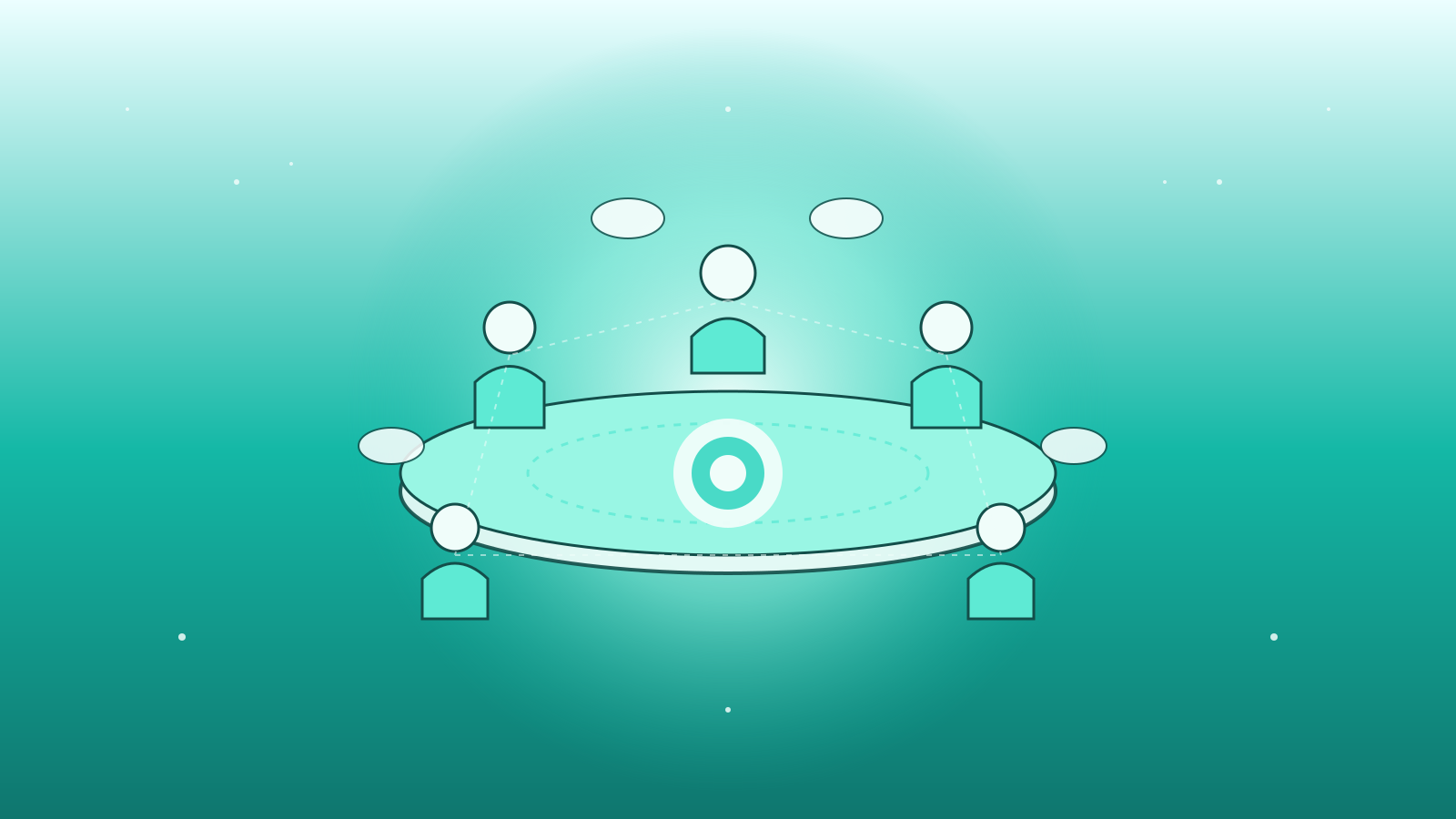
Edmondson's Discovery: 'The One Common Trait of the Best Teams'
While studying medical teams in the 1990s, Harvard Business School organizational behavior scholar Amy Edmondson noticed something strange: 'The highest-performing teams report the most mistakes.' At first she hypothesized that higher-performing teams simply made more mistakes, but as the research deepened the truth emerged.
High-performing teams were not making more mistakes — they had a culture in which it was safe to report them. Low-performing teams, by contrast, punished anyone who admitted error, so everyone stayed silent, and small mistakes grew into serious accidents.
From there, Edmondson formalized the concept of 'psychological safety.' She defines it as a shared belief that 'on this team, I can speak up without being seen as ignorant, incompetent, intrusive, or negative.' This shared belief, she argues, is the single foundation for building the best teams.
What Google's 'Project Aristotle' Proved
The largest-scale validation of this theory was Google's 'Project Aristotle,' a four-year study starting in 2012. Google examined more than 180 internal teams to answer the question: 'What do the best teams have in common?'
Going in, the hypotheses were many — members' educational background, personality fit, years of experience, the balance of introverts and extroverts. But after four years of tracking, the surprising conclusion was that nearly all of these factors didn't matter.
The single decisive ingredient of the best teams was exactly what Edmondson had defined — psychological safety. Google announced it openly: 'Whether members feel safe to speak up determined virtually all of the productivity and creativity of the team.' Degrees, experience, and titles meant almost nothing in the face of psychological safety.
The Words With Which Satya Nadella Revived Microsoft
When Satya Nadella became Microsoft's CEO in 2014, he dramatically transformed a stagnating giant into a 'learning organization.' At the center was his line: 'Build a culture of learn-it-alls, not know-it-alls.'
Before Nadella, Microsoft was steeped in a climate where 'admitting what you don't know lowers your evaluation.' In meetings, everyone pretended to know, and no real debate took place. This is a textbook symptom of a low-psychological-safety organization.
Nadella elevated 'the courage to say I don't know' and 'the flexibility to learn from others' as the company's most important values. He frequently opened executive meetings with 'this is something I don't know, please teach me,' embodying as a leader a culture in which ignorance is not shame. Microsoft's share price nearly multiplied tenfold, and it became the world leader in cloud. Psychological safety is not a soft sentiment — it is a core management strategy.
Kazuo Inamori's 'Compa': A Dialogue Culture
Kazuo Inamori, founder of Kyocera, embedded a unique dialogue culture in his organizations called 'compa.' It is not just a drinking party — it is a setting where rank is set aside so that people can speak from the heart. Inamori said again and again, 'People are moved not by logic but by heart. For the heart to move, people need a relationship in which they can let their true feelings collide.'
In Inamori's compa, junior staff were encouraged to state their views openly even to executives. Executives were forbidden to counter or scold immediately; first, they were to listen to 'why do you think so' to the end. This rule of listening was what turned compa from idle chat into a device that cultivated psychological safety.
Inamori put it this way: 'They say etiquette follows enough food and clothing — but management follows enough dialogue.' The total volume of dialogue in which people can voice their real feelings determines the speed and quality of an organization's decisions. This field wisdom aligns perfectly with Edmondson's theory of psychological safety.
Five Actions a Leader Can Practice Starting Today
Psychological safety is not an abstract concept — it is built by the accumulation of concrete leader behaviors. Here are five you can start today.
First, disclose your own failures first. When a leader speaks candidly about their own mistakes or things they don't know, members learn that 'failure is safe to talk about here.'
Second, ask a question before negating a remark. Instead of 'that's wrong,' reply with 'can you tell me a bit more?' That alone lowers the bar to speaking up dramatically.
Third, create speaking room for those who stay silent. Don't leave meetings to the loudest voices — deliberately ask, 'What do you think, [name]?' That alone unlocks the team's collective intelligence.
Fourth, thank the person who delivers bad news first. Replace 'why didn't you say sooner?' with 'thank you for telling me.' That one opening line changes the reporting culture.
Fifth, decouple disagreement of ideas from emotional opposition. Show through both words and posture, 'I disagree with your opinion, but I respect you.' Members will be able to speak up without fear.
Keep practicing these five, and in roughly three months the air in the team will demonstrably change.
The Night No One Spoke, and the One Sentence I Changed
A personal aside. There was a period when I led a recurring meeting in which, no matter what topic I raised, no one would speak. Materials were distributed, the points were organized, and I would ask, 'Any thoughts?' — and both the room and the screen on the other side would go silent. On the way home I kept asking myself, was it my way of running it, or had people lost motivation?
One day I decided to try reviewing my own approach once more, and at the very start of the meeting I added one line: 'Honestly, I'm wrestling with this myself. I'd like to hear your candid views.' The first person to respond was a junior member who almost never spoke, who began with, 'Actually, something has been bothering me for a while.'
In that moment I realized that what changed the air in the room wasn't the quality of my questions or framing, but the single sentence in which I had let my own uncertainty show first. Psychological safety isn't about performing as a flawless leader — it grows from the courage to expose your own vulnerability just a little, ahead of others. I still remember the weight of that junior member's first sentence on that evening.
Psychological Safety Is Not a 'Soft' Workplace
This is where many people misunderstand. They confuse psychological safety with 'a kind workplace' or 'a conflict-free workplace.' Edmondson is firm: 'A psychologically safe workplace is not a workplace without conflict. It is, rather, a workplace in which conflict can be staged constructively.'
In truly high-performing teams, fierce debate happens every day. The difference is that the debate is a fight of ideas, not a personal attack. Even when one's opinion is rejected, one does not feel personally rejected — and that relationship is the soil that grows the best performance.
At the intersection of 'psychological safety x high standards' is where you find the strongest organizations: Google, Microsoft, Kyocera. Safety alone produces a 'soft workplace.' Standards alone produce a 'workplace of fear.' Holding both at once is the real job of the modern leader.
Add a Drop of Safety to Your Team Today
Edmondson's research, Google's large-scale experiment, Nadella's organizational transformation, Inamori's compa — though spanning different eras, countries, and industries, all point to the same conclusion: 'People deliver their best performance only in a place where they can feel safe.'
You don't need to wait for a grand reorganization. In tomorrow's meeting, share one thing honestly that you don't know. Ask the quietest person 'what do you think?' just once. To the subordinate who brings bad news, say 'thank you' first.
That single drop of action will, little by little, soak psychological safety into your team. And six months, a year from now, when you look back, you will be the one most surprised to find the best team you have ever worked with standing right in front of you.
About the Author
Success Quotes Editorial TeamWe share timeless quotes from the world's greatest achievers in a way that is easy to understand and applicable to modern life.
View author profile →Related Articles
"Your Brand Is What People Say About You When You're Not in the Room" — Jeff Bezos on How Reputation Builds Your Network
"It Is Not Enough to Be Busy — So Are the Ants. The Question Is, What Are We Busy About?" — Thoreau on Turning Busyness into Real Results
"Show Them, Tell Them, Let Them Try, Then Praise Them" — Isoroku Yamamoto on Leadership That Actually Moves People
"The Essential Thing Is Not to Have Conquered but to Have Fought Well" — Baron de Coubertin on Acting Beyond the Tyranny of Results